Home Blog Page 64

Pleasure Of Giving Succour To Rickshaw Pullers In Sweltering Heat

0

It was an occasion coinciding with the beginning of the Rotary year. And, what better way to celebrate than help give succour to the profusely sweating men pulling the rickshaws on city roads in this sweltering heat. Rotary Club of Chandigarh on Sunday made a good choice while launching ‘Rotary Rahat Programme’, presenting two dozen-odd rickshaw pullers outside Aroma Hotel in Sector 22 a set of insulated water bottle and a towel each. Later, Rotary Club of Chandigarh volunteers fanned out in different directions of the city and a couple of adjoining villages to distribute the sets to other rickshaw pullers.

The pleasure of giving was seen to be believed as the first rickshaw puller, a young man from Uttar Pradesh, took out the presented water bottle from its insulation cover and took a hearty gulp of the refreshing cold water. Senior Superintendent of Police (Traffic & Security) of Chandigarh Police Shashank Anand and young volunteers from Rotary Club of Chandigarh presented the sets to the beneficiaries.

Photos By : Life In Chandigarh

Club President AP Singh told lifeinchandigarh.com that initially 500 sets will be distributed among rickshaw pullers outside hospitals, inter-state bus stands, Railway station, and important road junctions in the city, besides Dhanas and Saketri villages.

He said Rotary Clubs were focussed on service of the community and they continue to provide assistance to the poor and the needy in several ways, which include organising health camps in the slum areas. “This idea of giving water bottles and towels to rickshaw-pullers in the height of summers came from veteran Rotarian Kanwal Bedi, and what better day to start the programme than on the first day of the Rotary year,” Singh added.

Doctors Admit Rift With Patients, Show Serious Intent To Bridge Gap

0

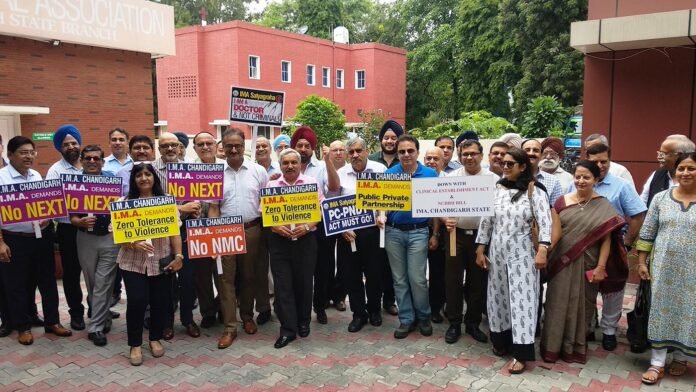
When an invitation came from Dr. Neeraj Kumar, President of the Chandigarh Chapter of Indian Medical Association, for a symposium on “How to Improve Doctor-Patient Relationship” and a blood donation camp to coincide with World Doctors’ Day on Sunday, I was caught in two minds, whether or not to go for such a programme, which in common knowledge is a sham affair. Finding nothing much on my hands on a lazy Sunday, I finally convinced myself to go anyway, if only to touch base with doctor friends I had not met for a long time. Sitting through to the end of the nearly three hours of focussed discussions, which were interspersed with moments of heated dissent from veteran doctors and general public alike sitting in the audience, I was pleasantly surprised to witness the medical fraternity seriously acknowledging the disconnect with the patients and showing willingness to make amends to win back their faith and confidence in the noble profession that once was, and perhaps still deserves to be.

First up, both the keynote speakers, and more than half a dozen panellists, were top notch and from varied backgrounds. Moreover, they appeared to have come prepared with a willingness to listen to dissent. And, dissent the panellists, who included senior private and government sector doctors, an internationally recognised consumer advocacy expert, a senior journalist and a senior lawyer, received in fair measure from veteran doctors and general public in the audience, who sought to break protocol to get themselves heard from the  patients’ perspective.

Photos By : Life In Chandigarh

The panellists

It was left to chief guest Justice Mahesh Grover, Judge of the Punjab & Haryana High Court, to cool tempers as he stood to give his straight-from-the-heart address, which received rapt attention from one and all in the audience. Interspersing his thoughts with personal experiences to make his point, he did not mince words in hitting out at the government, which in his personal view, had blundered in bringing the medical field under the ambit of the Consumer Protection Act. At the same time showing a mirror to the medical fraternity, he urged them to get their act together and mercilessly weed out the black sheep who had brought disrespect to the noble profession in the eyes of the general public.

Pointing out that the topic chosen by the organisers for the symposium itself revealed the deep realisation of failing which has crept into the medical profession, Justice Grover, said at the same time it also showed willingness on the part of the medical fraternity to introspect, which is a good thing as constant introspection is the need of the hour as it invariably leads to good outcomes. In a lighter vein, he equated the situation to a husband making concerted efforts to win back the trust and confidence of his wife which he has lost because of his conduct.

He opined that this breach of trust between doctors and patients has not happened overnight, but over a long period of time. “The success of any profession lies in its public perception. If the medical profession feels it has lost the perception war, it needs to introspect as to the causes, and take early corrective measures.”

Remembering old times, he said, “Those days most of the clinical tests we have now were not available to the medical profession, and doctors largely relied on a patient’s examination and listening patiently to what he has to say regarding his ailment. It did wonders in creating trust with the patient.”

Justice Mahesh Grover

Suggesting that doctors in the modern age need to learn to open channels of communication with the patients, he said, “I am sure if they are able to do this, the larger part of the problem will resolve by itself. The patient knows best what he is going through, and after giving him a patient hearing a doctor knows best what his affliction is and what the line of actions needs to be. The lesser time devoted by a doctor in listening to a patient, and depending instead on clinical investigations, gives an impression to a patient that he is being made a guinea pig, that he is being experimented upon. In such a scenario, when a patient is required to spend a substantial amount of money on investigations he takes it as commercialisation of healthcare.”

Use Kind Words

Emphasising the importance of using kind words from both sides, which he felt made all the difference in building a strong bond of confidence and trust between a doctor and a patient, he quoted two examples from his own experiences to press home the point.

The first was of a former High Court Judge afflicted with a brain tumour and needing major life-threatening surgery telling his doctor, ‘your competence and my confidence will help us pull through safely.’  

The second example he gave was of his own concern for the safety of his new born son, who had a condition requiring surgery, and after the surgery was admitted to the neonatal ICU. “I was spending hours to be with my child out of concern for his safety. Seeing this, one day the attending doctor asked me why I am so worried when the child is being looked after well by the hospital staff. He reassured me that my son will be all right since he is in good hands and God is with him. Those words of comfort gave me intense confidence that my son will weather the tide. That empathy and compassion coming from the doctor did the trick.”

Patient Coming In Distress

Justice Grover signed off saying that the doctors must realise that a patient coming to them is not his normal self, but is in distress. In this condition, he needs a doctor’s attention, care and concern more than anything else, to assure him that he need not worry and will be all right.”

Earlier, in their keynote addresses Bejon Misra, international expert on consumer advocacy and founding board member of New Delhi-based ‘Patient Safety And Access Initiative of India Foundation’, and Dr. SK Jindal, former HoD, Deptt. Of Pulmonology, PGI, also spelled out steps that can be taken to rebuilt the fractured trust between the doctors’ community and the general public. Stressing the need for doctors’ to show greater compassion and empathy towards the patients, they also asserted that the interests of doctors should equally be safeguarded and they should not be prima facie held guilty on the basis of a complaint and then be expected to prove themselves not guilty. The onus of proving charges in a complaint should be on the complainant and concerned authorities in competent courts, they added.

The Panellists

Bijon Misra

The panellists included besides Bijon Misra, and Dr. SK Jindal, senior journalist Vipin Pubby, Dr Ashok Attri, HoD, Surgery & Emergency, GMCH-32, senior lawyer Alka Sarin, Dr. Yash Bala, senior gynaecologist, and Dr. Gurbir Singh, Regional Medical Director, North & East, Fortis Healthcare. The police remained unrepresented since a senior officer of the Chandigarh Police scheduled to join the panel failed to turn up. The panellists deliberated on various issues being raised in public domain like unnecessary surgeries, investigations and admissions, media’s role in improving doctor-patient relationship, privatisation of healthcare and profitability, commissions/cuts paid to doctors and expensive medicines being prescribed by doctors with an ulterior motive.

In the blood donation camp organised on the occasion, 80-odd volunteers donated blood.

First Of Its Kind Patient Support Group In City

Before making an abrupt exit in the middle of the deliberations to catch a scheduled flight, Bejon Misra, who is also founder at ‘Partnership For Safe Medicines’ and ‘Consumer Online Foundation’, announced a major initiative, in association with IMA Chandigarh, for the city to bridge the gap between doctors and patients, which he claimed would be the first of its kind in the country. It will be a patient counselling centre, to be initially housed in the IMA House in Sector 35-B, Chandigarh, where patients can come with their issues related to healthcare services, including grievances against doctors and hospitals, in Chandigarh.     

“It has been my dream project for the last 35 years. This will be the first time in the country that a patient support group in association with leading doctors’ organisation will start this type of service,” he asserted.

When Married Women Were Made To Feel Like Queens

0

To be bestowed the honour of a queen for a married woman is no less than a dream come true, but to be crowned at a glorious 60-plus age is like going over the moon. This is what 16 women from all walks of life experienced as they displayed grace, beauty, poise and glamour on the ramp while participating in three different age categories in the finale of the first ever Mrs India Punjab-2018 pageant, part of the larger Mrs India pageant, at the Ramada Plaza Chandigarh on June 25 night. The ‘youngest’ among the ladies of substance had crossed the 68 mark, and dazzled the indulgent audience like none else.

A helicopter pilot of the Indian Air Force, flying Cheetahs and Chetaks, Squadron Leader Garima Dixit ran away with the Mrs India Punjab-2018 winner’s title in the 18-40 years age group. The Classic Mrs India Punjab-2018 (age group 40-60) crown was worn by Sandhya Kulkarni, a multi-faceted personality – educationist, avid mountain trekker, painter and poet. The wiry Rashmi Sabharwal, winner of the Super Classic (60-plus) Mrs India Punjab-2018 title, is again a multi-tasker – an IELTS and English language trainer, certified Reiki practitioner and accomplished dance trainer, who also runs a fashion jewellery store.

Photos By : Life In Chandigarh

The stately Super Classic lady winners

Rashmi, in fact, gave a scintillating display of her dancing skills in the company of her equally lithe husband Col. (retd.) Sabharwal. The Cuban origin ‘cha-cha-cha’ dance to a Latin American tune had the audience at the edge of their seats.

Garima Dixit

First up, the pageant, an attempt to bring the Mrs India contest closer to the aspiring married women from Punjab, Chandigarh and around, was impressive, though it left scope for improvement. Organised and managed by Mrs India Punjab Director Jyoti Rupaal, herself a sub-title holder of Mrs Asia International Popularity Queen 2017 in China, the pageant attracted an overwhelmingly large number of applicants and contestants from Defence background, with Jyoti herself being from an Army family. Wider outreach in the coming editions could be an answer to larger and more broad-based participation.

Pooja Sharda

The pageant was organised under the patronage of Mrs India Pageants & Productions Pvt. Ltd., one and only National pageant for Indian married women, and official host for Mrs Tourism International, Mrs Asia International and Mrs Planet.

Jyoti Rupaal told lifeinchandigarh.com that they received 82 applications, out of which 39 contestants were selected for auditions, and further 16 were shortlisted for the finale. Since it was the first state level pageant, the Mrs India head office fully supported the Mrs India Punjab-2018 pageant, both financially and otherwise, she added.

Sucheta Bagri being crowned by Jyoti Rupaal (left) and Deepali Phadnis 

In the finale, the participants in all three categories first participated in a traditional dress round, followed by an introduction round. The talent round saw all but one of the finalists displaying their dancing skills to good effect, and a lone finalist winning hearts with a sweet song. The evening gown round was the most elegant of all the rounds.   

The concluding question-answer round, in which all finalists were asked to pen down in three minutes, and later read out their views on what they would do to empower women who were not as blessed as they were, saw an across-the-board dip in their performances.  

The Classic winners

Besides Jyoti Rupaal, the others on the judges’ panel were Chennai-based Deepali Phadnis, Managing Director of Mrs India Pageants & Productions Pvt. Ltd. and herself a Mrs Asia International title winner in 2012, Punjabi films producer-actor Manpreet Singh ‘Tony’ Popli and AKSS Medi Aesthetic & Cosmetology Clinic promoter Dr Sonia Oberoi.

The winners

Mrs India Punjab-2018 (18-40 years)

Winner : Squadron Leader Garima Dixit

1st Runner-up : Pooja Sharda

2nd Runner-up : Sucheta Bagri

Classic Mrs India Punjab-2018 (40-60 years)

Winner : Sandhya Kulkarni

1st Runner-up : Leena Sharma

2nd Runner-up : Geeta Dhull

Super Classic Mrs Indai Punjab-2018 (60-plus years)

Winner : Rashmi Sabharwal

1st Runner-up : Jyoti Dogra

2nd Runner-up : Kanwaljit Kaur Bains

Sub-titles

Mrs Beautiful Smile : Pallavi Airy

Mrs Photogenic : Rashmi Singh

Mrs Personality : Gurpreet Gill

Mrs Congeniality : Parminder Matharu

Mrs Graceful : Sarabjit Kaur

Mrs Talented : Ashi Parashar

Best Traditional Costume : Neelam Khatter

Mrs Vivacious : Pooja Sharda

There was also a special surprise award for Best Supporting Husband (for treating his wife like a queen 24X7 right through the contest), and it went to Col. Tejinder Singh.

All went home happy !! Overall, a well planned and designed event, executed with finesse !! A job well done, first up !!

‘Advanced Inorganics In Right Doses Can Sustain Organic Farming’

0

Organic farming cannot succeed in isolation, especially in a country of India’s size and population, with tremendous pressure on increasing productivity of crops to feed the teeming millions. It can only be sustained with judicious use of new generation agrochemicals, which require less dosage, ensure greater productivity and are more environmental friendly. Expressing these views, Rajesh Aggarwal, Managing Director of India’s leading agrochemicals company Insecticides India Ltd. (IIL), while announcing the launch of three new products – Encounter, Sophia and Aikido – in the Punjab market at a media conference in Chandigarh on Thursday, said while practising organic farming it would be foolhardy to assume that all diseases which will afflict the crops can be fought without the use of agrochemicals.

Comparing the consumption of agrochemicals in India with some of the advanced countries, Aggarwal asserted that it is a myth that India was among the highest consumers of these chemicals in the world. “The sale of agrochemicals in India is worth a mere 3 billion dollars compared to the worldwide figure of 66 billion dollars. The reason is Indian farmers are slow on the uptake of mode technologies, and the results can be seen in very low levels of productivity as compared to counties like USA and Brazil, where the consumption patte of agrochemicals is much higher,” he informed.

Photo By : Life In Chandigarh

“At IIL, it is our continuous endeavour to develop the latest crop protection products for the benefit of farmers which are economically within their reach. All three new products, developed either in our in-house R&D centres or in technical collaboration with Nihon Nohyaku, Japan, are based on the latest technology and safe formulations and will find wide applicability,” Aggarwal claimed.

IIL is also working big time with farmers in Punjab to educate them not only about the right dosages of pesticides and fungicides and spraying techniques to be used, but also advising them on use of seeds and fertilisers to achieve best results and to cut down on wastages. Sharing details regarding this farmers’ outreach programme of the company, General Manager Sanjay Vats said last year the company through a strong network of its agri experts spread across the state could reach out to 20,000 farmers by organising 60 mega farmers’ meets, 350 spot meetings and 600 ‘nukkad’ meetings.

Asked about the size of the agrochemicals market in Punjab, Aggarwal said “In quantity terms, the use of agrochemicals is not increasing because advanced technologies require lesser dosage. But, in value terms, it is increasing and it stands at an estimated Rs. 1700-1800 crore. The overall Indian market for agrochemicals is of the order of Rs. 17,000-18,000 crore, he added.

Sharing financials of the company, Aggarwal claimed that in 2017-18 its top line stood at Rs. 1109.23 crore. “Last 3-4 years have been difficult years and we could manage only a single digit growth. But, we are hopeful of clocking 15 percent continuous growth from this year.  Last year, IIL’s exports were of the order of Rs. 35 crore, which we have targeted to double this year.” 

Govt. Hospitals On Fast Track In Punjab Could Signal Relief For PGI

0

At long last, the overburdened prestigious regional super speciality government institute for medical education and research, PGI Chandigarh, may be able to derive some comfort from moves afoot in cash-strapped Punjab to give a facelift to its health services. In a meeting to review functioning of the Medical Education and Research Department, on Thursday, Chief Minister Capt. Amarinder Singh cracked the whip for expediting work on upgrading the Mohali Government Hospital to a Medical College and Hospital by adding 100 more beds to the existing strength of 200, completing basic infrastructure for early construction of AIIMS Bathinda by the Centre, opening of PGI satellite centre at Ferozepur, restoring the glory of the Patiala Medical College and Hospital with infusion of more funds, and speedy planning for opening two new medical college and hospitals at Sangrur and Gurdaspur or Pathankot.

Aiming to come down heavily on unprofessional private medical colleges operating in the state, the Chief Minister asked the Vice Chancellor of Baba Farid University of Health Sciences (BFUHS) Dr. Raj Bahadur to ensure that students were not duped by these institutions and that they followed all Medical Council of India norms. The university should not hesitate in taking stern action against erring institutions by closing down courses or shutting down the institutions altogether, if needed, he asserted.

Photo By : Life In Chandigarh

Additional Chief Secretary Health Satish Chandra was instructed to immediately take up with the Central Government the issue of approval for a satellite centre of PGI Chandigarh at Ferozepur, for which a 25-acre plot had already been identified at Mallwal Kadim village near Wazidpur.

Similarly, Capt. Amarinder Singh sought the department’s greater indulgence in getting the central government to complete the construction of AIIMS Bathinda within the stipulated time-frame. The Finance Department was asked for early release of funds for completion of Punjab’s commitment towards basic infrastructure works associated with the project, like a 66 KV sub-station, shifting of power lines, water channel, approach road, etc.

Seeking a comprehensive plan for up-gradation of infrastructure and faculty to restore the glorious legacy of the Patiala Medical College and Hospital, the Chief Minister directed the Finance Department for immediate release of Rs. 65.95 crore towards execution of new works in the institution, including a multi-level parking, renovation and repair of TB Hospital and new ambulances. The meeting was informed that funds had already been released for installing sewerage treatment plants and repair of sewage lines.

Capt. Amarinder Singh emphasised on the Medical Education and Research Department to regularly convene meetings of the departmental promotion committees to ensure seamless time-bound promotions of the medical faculty.

Health Minister Brahm Mohindra, Finance Minister Manpreet Singh Badal, Principal Secretary to the Chief Minister Tejveer Singh, Finance Secretary Anirudh Tewari, Director Medical Education and Research Dr. Avinash Kumar, OSD Medical Services to the Chief Minister Dr. Girish Sahni and Principal of Patiala Government Medical College and Hospital Dr. B.S. Sidhu were among others who participated in the meeting.

Real Time Online Data Analysis Will Help Improve Patient Safety

0

With on an average 10,000-plus OPD patients visiting the prestigious PGI Chandigarh daily, and more than 200 surgeries being performed in its 50-odd operation theatres every day, the behemoth has so far been maintaining the astronomical amount of vital data of patients manually, leaving little scope of its retrieval for long term follow up care of patients, medico legal purposes and medical studies and research. On Tuesday, PGI, after more than two years of painstaking work, began a process of rolling out a first of its kind information management system (IMS) among all government hospitals of its scale in the country, which will generate second to second online data real time to be stored in the premier institution’s own servers.

As PGI Director Prof. Jagat Ram formally launched the highly advanced IMS, initially to be available to the Anaesthesia Department in four operation theatres in the Advanced Cardiac Centre, it heralded the opening of a new chapter of public-private partnership in the history of the medical institute. For the entire intricate software part of the system, the PGI owes its thanks to the benevolence of Indian IT giant Infosys Ltd., which custom built the open source software (not requiring any licenses) for the PGI free of cost, deploying a full time team of four to five professionals for a good 18 months for the purpose.      

The PGI Director informed that the facility of IMS will gradually be extended to all 50 OTs, ICUs, other advanced centres and to the main Nehru Hospital as and when funds are released for purchasing more hardware to run the system. It will also be integrated with the Hospital Information System (HIS), which is already operational but so far is being put to limited use, he added.

A brainchild of Prof. GD Puri, Head, Department of Anaesthesia & Intensive Care, the first phase of the IMS developed by Infosys Ltd. has the capability to interface and aggregate data from all equipments linked to a patient in an operation theatre like anaesthesia machine, infusion pumps, vital sign monitor and ventilator, etc. and to access a patient’s data real time from distant locations.

Prof. Puri told media persons that besides making the data collection paperless, IMS will lead to increased accuracy and completeness of clinical documentation, robust real time second to second data recording and increased operational efficiency of the clinicians / anaesthesiologists. From the research perspective, it offers opportunities for big data analysis and predicting critical events in advance so that necessary pre-emptive actions can be taken for patient safety, he added.

Describing the development as a big step towards PGI forging a fruitful partnership with private industry for the good of society, PGI Dean Academics Prof Rajesh Kumar however said the ultimate test of the system will be to demonstrate that its deployment has lead to improvement in patient outcomes. Acknowledging that IMS will infuse transparency in the functioning of the institute, he also advocated deployment of IT in other critical areas like teaching and research.

Speaking on the occasion, Sunil Jose, Associate VP and Delivery Head, Engineering Services, Infosys Ltd., said “We have developed this open source customised software for PGI free of cost to build a relationship with the premier health institute of the country.” Giving an overview of Infosys Medical Devices Practice worldwide, he said Infosys is looking forward to exploring more opportunities for further collaboration with PGI on a case to case basis.

Taking A Cue From Centre, Punjab To Disinvest 3 Large PSUs

0

Desperate to come out of the financial crisis in the state and get moving to urgently generate funds for capital expenditure and infrastructure development, social welfare schemes and improving performance of Public Sector Undertakings (PSUs) by instilling professional and corporate business ethics, the Capt. Amarinder Singh Government in Punjab has initiated the process for disinvestment of three of the ailing large PSUs.

The decision to disinvest the now loss-making, but once robust Punjab Communications Limited (Puncom), Punjab Financial Corporation (PFC) and Punjab State Industrial Development Corporation (PSIDC) was taken by the state cabinet on Wednesday, based on the recommendations of the Punjab Governance Reforms and Ethics Commission (PGREC).

The process of disinvestment of these PSUs to be followed would be recommended by a Core Group of Officers, to be set up under the chairmanship of the Chief Secretary, and assisted by a Transaction Adviser. The report of the Core Group would be submitted to the Council of Ministers for a final decision. Other members of the Core Group would be Principal Secretary Finance, Principal Secretary to the Chief Minister, Administrative Secretary of the concerned department and Managing Directors of the concerned PSUs. Director Public Enterprises and Disinvestment would be its Member/Convenor.

In taking the decision to disinvest, the cabinet took note that the State earned only Rs. 4.90 crore as dividend in 2017-18 from its 50-odd PSUs, while the state resources locked up in these PSUs amounted to a staggering Rs 7614 crore. The total amount of outstanding government loans of these PSUs is a whopping around Rs 25,393 crore and the unpaid loan against Government guarantee stood at Rs. 18,312 crore approximately as on March 31, 2018 (provisional).

The cabinet was influenced by the Central Government collecting around Rs. 1 lakh crore from the strategic and non-strategic disinvestment of Central Public Sector Enterprises (CPSEs) in 2017-18, taking advantage of the market conditions.

Enriching Her Dance Form & Keeping Local Cultural Flavours Alive

0

She is an international exponent of ‘kathak’ dance. But her love for poetry, and a deep sense of responsibility towards keeping alive the essence of regional language, art and culture, has inspired her to make subtle but refreshing innovations in her dance performances. The idea is to use the popularity of ‘kathak’ to expose audiences to these beautiful art forms which are steadily losing visibility, but lie enshrined in scattered pieces of hard-to-find literature.

On one of her visits to the city to present a dance drama “Pryutsu”, an ode to our warriors coinciding with commemoration of 75 years of Quit India Movement, at Tagore Theatre on Monday, young Sanchita Abrol, who hails from Jammu and is currently based out of Melbourne, Australia, says: “There is a depth and beauty in the literature and music of the many cultures and communities across India. As an Indian classical dancer, I feel a sense of responsibility to bring these cultures to the audiences. This way, the bonds within communities, and the bonds between communities are strengthened, and so is the fabric of Indian society.”

Photos By : Life In Chandigarh

Pryutsu” is based on the classical Dogri poetry by (Late) Group Captain Randhir Singh, also popularly called ‘Kunwar Viyogi’, the only Indian Air Force officer to be conferred the Sahitya Akademi award. It also integrates the time-honoured poetry by Padma Bhushan awardee and freedom fighter Mahadevi Verma and English poem “The Valley Roars” by Ayushman Jamwal, author of the book “Chameleon Lights”. This dance drama, as also all her other performances, are curated, scripted and directed by Sanchita herself.

One of the upcoming projects she has been working on for the past one year and is nearing completion involves reimagining Ladakhi community from its lesser known literary origins and to depict these aspects through ‘kathak’ on the world stage. “As Ladakh is located on a traditional trading route between India, Tibet, and Central Asia, it absorbed different cultural influences. This resulted in hybrid characteristics of Ladakhi folk literature, music and dance which I want to bring alive in my upcoming project,” she informed.

“One of the challenges of integrating the true flavours of these cultures in my dance performances is that literature is available somewhere but you have to dig it out by personally visiting and spending time in the heart of these cultures. Once the literature is found, which is always in the local script, the next issue is to find a decent translator. And finally the arduous task of seamlessly integrating the regional culture in the dance performance in a manner which is easily understood and at the same time is engaging, too,” Sanchita said.

Taking to dance at a tender age of 5, Sanchita Abrol honed her skills in ‘kathak’ under the guidance of Padma Shri Shovana Narayan. She quickly gained nominations to perform at prestigious platforms like SAARC (South Asian Association for Regional Cooperation) and Asia Sammelan.

In 2014, Sanchita founded ‘Rasadance’, an organization in Australia, to build a bond with the centuries old tradition of story-telling through dance. She has performed on many national and international stages and has represented India at Ganges Danube Festival in Hungary and Multicultural Festival in Melbourne. She was also part of an Indian youth delegation to China.

The ‘kathak’ exponent has been honoured with ‘Prem Jamwal Art Innovation Award’ for revitalising ‘Dogri’ poetry, with a unique blend of Hindi and English literature and presenting it on international stage through her dance. She has choreographed and featured in Dogri ghazal videos “Aayi Khushboo” and “Rasam Riwaz”. 

Sanchita has worked with many eminent poets like Padma Shri Padma Sachdeva and Padma Shri Dr. Shyam Singh Shashi. She also appeared in the ghazal album “Dekho Toh” by the well-known poet Farhat Shahzad from Pakistan.

New 3-Year Civil Services Integrated Course For 10+2 Passouts

0

Students aspiring for Indian Civil Services can now look forward to getting structured coaching for the prelims and mains examination immediately after passing their 10 + 2 examination, while simultaneously pursuing their college studies. The largest civil services coaching academy in the country, Chanakya IAS Academy, on Sunday announced the launch of its first batch of three-year integrated course at Rs 2.2 lakh plus taxes from July 20, 2018 as it steps into its silver jubilee year.

Briefing media persons after conducting a free seminar for aspiring civil servants at the Chandigarh centre of the academy, where five students from the last batch of the academy who cleared the civil services examination 2017 were also felicitated, Founder of the academy A.K. Mishra said 355 of the 990 candidates who cleared the examinations 2017 were students of the academy, which has 20 branches across the country and institutional tie-ups with a host of colleges and universities. Out of these, five students got into the top 10 positions, 11 in the top 20 and 42 students in the top 100 positions, he claimed, adding that the academy was making arrangements to extend its coaching to smaller towns through live video streaming of classroom lectures from bigger centres. 

Photos By : Life In Chandigarh

Presenting two of the toppers before the media persons – Ayush Sinha (Rank 7) and Abhilash Barnwal (Rank 44) – Mishra informed that though Uttar Pradesh continued to throw up the highest number of successful aspirants in the civil services exam, the selections were witnessing much more “democratisation” in recent years from the time when candidates from Uttar Pradesh and Bihar used to hold sway. Among the smaller states, Haryana is doing very well. Out of the 53 successful candidates from among Punjab, Haryana and Himachal Pradesh, Haryana alone accounted for 27, while Punjab’s share was 17, Himachal Pradesh (3) and Chandigarh (6), he added.

Mishra’s ‘Art of Success’ system is claimed to be based on a trademark model ‘Human Software Development Programme’, a blend of clinical psychology, NLP (neuro linguistic programming), physiological study, etc. “Through Art of Success Programme we aspire to empower, inspire and programme human mind to achieve success in every sphere of life,” Mishra maintained.

Asked for his take on maintaining a professional line of duty in the wake of increasing political interference in the day to day functioning of the bureaucracy in the country, the 7th ranker, Ayush Sinha said he considered political pressure per say as legitimate since the politicians were under pressure from their electorates to perform and they were in turn justified to transfer this pressure onto the bureaucracy, the executing arm of the government. “But any sense of corruption or nepotism in their actions needs to be opposed by all means. One needs to strike a balance between executing directions issued by the political leadership and maintaining one’s value system and integrity,” he asserted.   

On ways to de-stress during the gruelling preparations for the civil services examination, Ayush said there cannot be a single way of de-stressing for all. Everyone has his own way of letting out the steam. “For me it was sharing tea and chatting up with family members and friends,” he added. Seconding Ayush’s observation, 44th ranker Abhilash Barnwal said some of the aspirants he knew pursued various hobbies as a way to de-stress, like playing a guitar, learning different languages, etc.

Others who were feted on the occasion were Megha Arora (Rank 108), who by choice had opted for IFS, and Agam Singh Bedi (Rank 332), who has decided to give any try to make it to the IAS. The cut-off rank for IAS 2017 was 95. 

Restore Skin Colour At One Of Worlds Best Centres In PGI

0

This is one disease which is neither contagious nor has an impact on our general health, but leaves our self esteem in tatters. There are a host of unfounded myths attached to it, apart from the immensely stressful psycho-social stigma. Just a few noticeable white patches on the fingers and mouth area make us the focus of prying eyes. Vitiligo or leucoderma (‘fulvairi’ in Hindi), widely believed in medical circles as an autoimmune condition in which the body’s defences turn against our own cells, instead of attacking invading germs, thereby destroying the pigment-forming cells in the skin known as melanocytes, has no relation whatsoever to the food we eat and is definitely treatable.

Seeking to remove many of the misconceptions around the medical condition on World Vitiligo Day, on Sunday, Prof. Davinder Parsad claimed that the Department of Dermatology at PGI Chandigarh is recognised worldwide as one of the best centres for research and medical as well as surgical management of vitiligo. No wonder that a special vitiligo clinic run every Friday at the PGI attracts 90-100 patients from across the country every week, up from 30-40 till a few years ago.

Photos By : Life In Chandigarh

Explaining the various treatment modalities, he said that to stop further spread of the medical condition, the department is using immune suppressants, including steroids. It already has advanced photo therapy machines and is expecting still more advanced machines to be added in the coming months. Once the spread of vitiligo has been contained, some surgical techniques, like applying cells from skin extracted from other parts of the patient’s body to the affected area, are also being used. Research in newer drugs being conducted in some parts of the world holds out promise for a breakthrough in the treatment of vitiligo in the next couple of years, he added.

Dr Parsad said as in many other medical conditions, early diagnosis is of utmost importance in treating vitiligo. The medical condition affects 1% to 4% of the population worldwide. In 40-50% of cases, signs of vitiligo start appearing among children in 4-5 years age group while in others it largely reflects in the age group 19-20 years. The patch is very white in case of vitiligo with normal sensation but no itching or redness. If detected at an early stage, it can be successfully treated within about two months, but with the coverage of upto 10 percent of the body, it could take up to six months for the pigmentation to be completely restored.

“We held an interactive session with patients of vitiligo today to refute myths and misconceptions regarding the medical condition. We also staged a short play to emphasise that vitiligo, which is often equated to leprosy, is not contagious. It has no relation to the food we eat. It is understood to be an autoimmune condition, which has only a 6% chance of being passed on to children bo to affected parents,” he informed.

“We often get young girls of marriageable age affected by vitiligo coming in, desperate to be fully treated within six months in time for their planned wedding. We advise patients not to get stressed, as increased stress is known to retard pace of treatment. While being treated, patients can use cosmetics like water proof foundations, which can camouflage the discolouration for up to a week with a single application,” Dr Parsad said.

Advising people affected by vitiligo against going to quacks for treatment, he said ill-informed patients, who make up an estimated 20-30 % of the total footfall at the special weekly clinic, have aggravated medical condition because of their unsuccessful engagement with quacks.